
From Donor to Patient: How Jeevadhaara is Changing Blood Donation in Kerala
In healthcare, a few seconds can mean the difference between life and death. Think of a mother facing sudden complications during childbirth, a small child undergoing cancer treatment, a person rushed to the hospital after a highway accident, or someone undergoing open-heart surgery. All of them need one critical thing to survive: the right blood group, delivered at the exact right time.
For many years, the system behind blood banking in India ran on manual paper registers, frantic phone calls to friends and relatives, and disconnected systems. Finding a donor was mostly left to a family's desperation during an emergency. Trying to find out if a distant hospital had a matching blood group meant calling around blindly.
Even after finding blood, there was another hidden danger: keeping it safe. Blood needs continuous, strict temperature control from the moment it leaves a donor's arm until it reaches a patient. If the temperature drops or rises too much, the blood spoils.
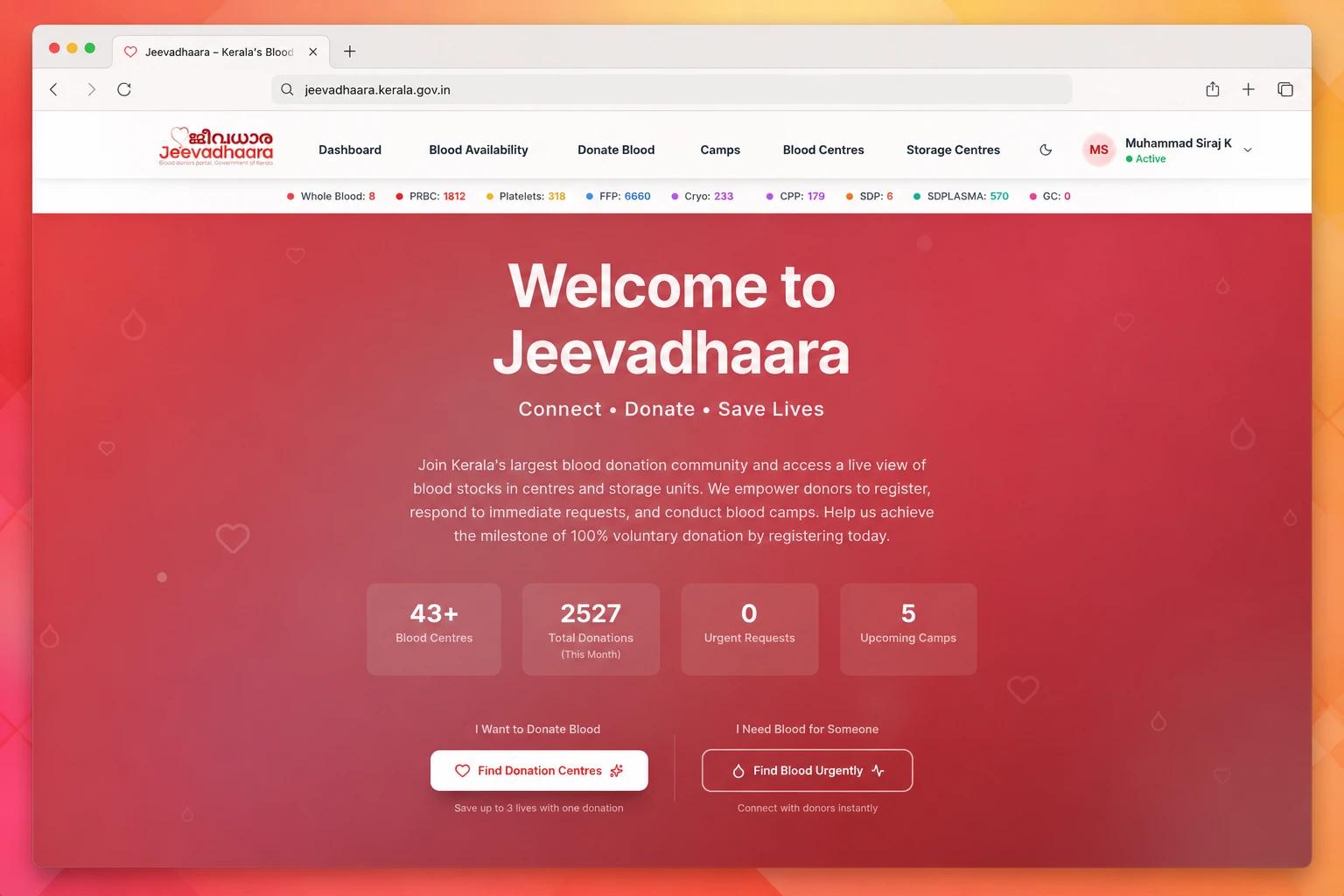
To fix these problems completely, the Government of Kerala introduced Jeevadhaara. Developed by healthcare technology provider BAGMO, Jeevadhaara is a single, unified digital platform. It brings together common citizens, blood banks, storage centers, hospitals, and local donation camps into one connected network across the state.
What is Jeevadhaara?
For everyday people, Jeevadhaara works as an easy-to-use website or citizen portal. But behind the screen, it is a powerful statewide Blood Bank Management System built to handle the complex logistics of blood supply.
The main goal of this initiative is simple: Safe Blood for Every Patient and 100% Voluntary Blood Donation.
Jeevadhaara is not just a simple list of donor phone numbers. It connects everyone together in real-time. It helps ordinary people register as active donors, lets blood bank officers track their live stock, gives emergency doctors immediate information on available blood nearby, and helps groups organize public blood donation camps in every district. This completely removes the panic and guesswork during medical emergencies.
Why Managing Blood is Formidable
Blood is not like ordinary medicine that you can store on a regular shelf. It is a living human tissue that spoils quickly, which creates major operational challenges:
- Short Expiry Timelines: Different parts of blood last for different periods. While Packed Red Blood Cells (PRBC) can be stored for about 35 to 42 days, Platelets—which are crucial for cancer patients—last for just 5 days and must be kept continuously moving in a special machine.
- Different Components: Patients rarely need "whole blood." Modern medical treatments require specific components, such as Packed Red Blood Cells (PRBC), Fresh Frozen Plasma (FFP), Platelets, Cryoprecipitate, or Single Donor Platelets (SDP).
- Extreme Temperature Sensitivity: If blood is kept outside its safe temperature zone even for a short time, harmful bacteria can grow, or the blood cells can destroy themselves. This makes the blood unsafe and highly dangerous for a patient.
In the old system of paper diaries and phone calls, tracking these details across hundreds of hospitals was nearly impossible. Blood bags often expired unnoticed in the back of a fridge, while a patient in a nearby hospital faced a life-threatening shortage of that exact same blood group.
Live Tracking via Advanced IoT and RFID
To bring total transparency to the system, Kerala’s centralized software uses Radio Frequency Identification (RFID) tags and Internet of Things (IoT) sensors. This creates complete "vein-to-vein traceability."
When a volunteer donates blood at a camp or hospital, an RFID tag is attached to the blood bag. This technology automatically records a continuous digital diary for every single bag. The system logs where the bag is kept, the exact time of collection, and its expiry date. At the same time, smart IoT temperature sensors watch the environment 24 hours a day, 7 days a week. Whether the blood bag is resting in a city blood bank or traveling in a delivery vehicle through rural districts, its temperature history is constantly sent to the central system. If a refrigerator door is accidentally left open or a transport box loses its cooling, the system sends out instant alerts. This ensures that spoiled blood is caught and removed immediately, long before it can ever reach a patient.
How to Register as a Donor on Jeevadhaara
Becoming a registered donor on the Jeevadhaara portal is a simple digital process. The platform connects directly with state and national health systems to make signing up secure and straightforward.
1.Visit the Official Website:Under 2 minutes.
Open the internet browser on your mobile phone or computer and go to the official portal: https://jeevadhaara.kdisc.kerala.gov.in/.
2.Log In Securely:Requires Mobile OTP.
Click on the donor registration button. Enter the mobile number that is linked to your Aadhaar card. The system will send a secure One-Time Password (OTP) to your phone to verify your identity and open your registration form.
3.Connect Your Health ID (UHID):Automated Fetch.
The system will automatically check if you have an existing eHealth UHID (Unique Health Identifier) in Kerala's government network.
If you have a UHID: The portal will automatically fill in your basic details for you.
If you do not have a UHID: You can easily create a new one right there. Just enter your Aadhaar number to verify your details, and the platform will generate a fresh UHID for you instantly. Your personal details stay completely confidential and safe.
4.Complete Your Profile:Final Step.
Confirm your basic details, such as your blood group, home district, and contact preferences. Once submitted, your donor dashboard becomes fully active.

How the Portal Empowers Citizens and Donors
Once your registration is complete, the dashboard turns into a personal platform that gives you full control over your donation journey.
Checking Real-Time Blood Stock
Instead of running from hospital to hospital or posting randomly on social media during a crisis, anyone can log into the portal to check live blood stocks across Kerala. You can filter the search by district, blood group, hospital, and specific components like PRBC or Platelets. This lets families see exactly which nearby center has the required blood ready.
Urgent Blood Alerts
When a rare blood group is needed urgently or an accident creates a sudden demand, Jeevadhaara sends out targeted notifications. It alerts verified, eligible voluntary donors of that specific blood group who live near the hospital. This mobilizes real donors quickly without creating unnecessary crowds or confusion at the hospital doors.
Proactive Donation Requests
If you are healthy and want to donate blood, you do not need to wait for an emergency. You can log into your dashboard and submit a Request to Donate. This lets local blood banks and upcoming donation camps know that you are ready and available.
Smart Re-eligibility Reminders
You do not need to count the days on your calendar to know when you can donate again. The portal automatically tracks your mandatory medical rest periods (such as the standard 90-day gap between whole blood donations). As soon as it is safe for you to donate again, Jeevadhaara sends you a notification inviting you back.
Downloadable Certificates
To appreciate your noble act and maintain an official medical record, Jeevadhaara generates an official, verifiable blood donation certificate after every successful donation. Donors can view, download, and print this government-recognized certificate directly from their digital accounts at any time.
Protecting Patient Safety and Privacy
Patient safety is at the very heart of Jeevadhaara. By linking accounts to a secure, unique health identity (UHID), the system removes duplicate records and prevents human data-entry mistakes.
More importantly, it builds a secure Statewide Deferral Registry. If a donor is found to have a blood-borne illness, shows high-risk medical markers, or is temporarily deferred by a doctor (due to recent medication, low hemoglobin, or travel history), this status is instantly updated across the entire connected network in Kerala. A donor who is temporarily deferred at a small rural clinic cannot travel to a major city hospital to donate blood accidentally. This ensures that only high-quality, completely safe blood reaches patients.
Your Data is Safe: In line with national privacy rules, Jeevadhaara uses identity integrations strictly for verification and security. Your actual sensitive identification numbers are completely masked and hidden within the software backend to keep your identity confidential.
Rewriting the Future of Public Health
Jeevadhaara highlights how a digital system can transform public healthcare by making daily operations smooth for everyone involved:
- Blood Bank Officers can replace old paper logbooks with automated digital records, instantly see upcoming expiries, and manage their stock efficiently to minimize waste.
- Hospital Doctors get an immediate view of blood surpluses in nearby districts, making it easy to transfer life-saving blood bags quickly during major accidents.
- Camp Organizers can easily apply online to host blood donation drives, manage volunteer lists, and display their camp schedules publicly so local citizens can find them easily.
Through this collaborative effort between the Kerala Health Department, K-DISC, the Kerala State AIDS Control Society, and technology partner BAGMO, Jeevadhaara provides a modern framework for public health management. It proves that technology works beautifully when it acts as a quiet guardian—protecting the cold chain, saving precious resources, and smoothly connecting a willing donor to a patient fighting for life.